

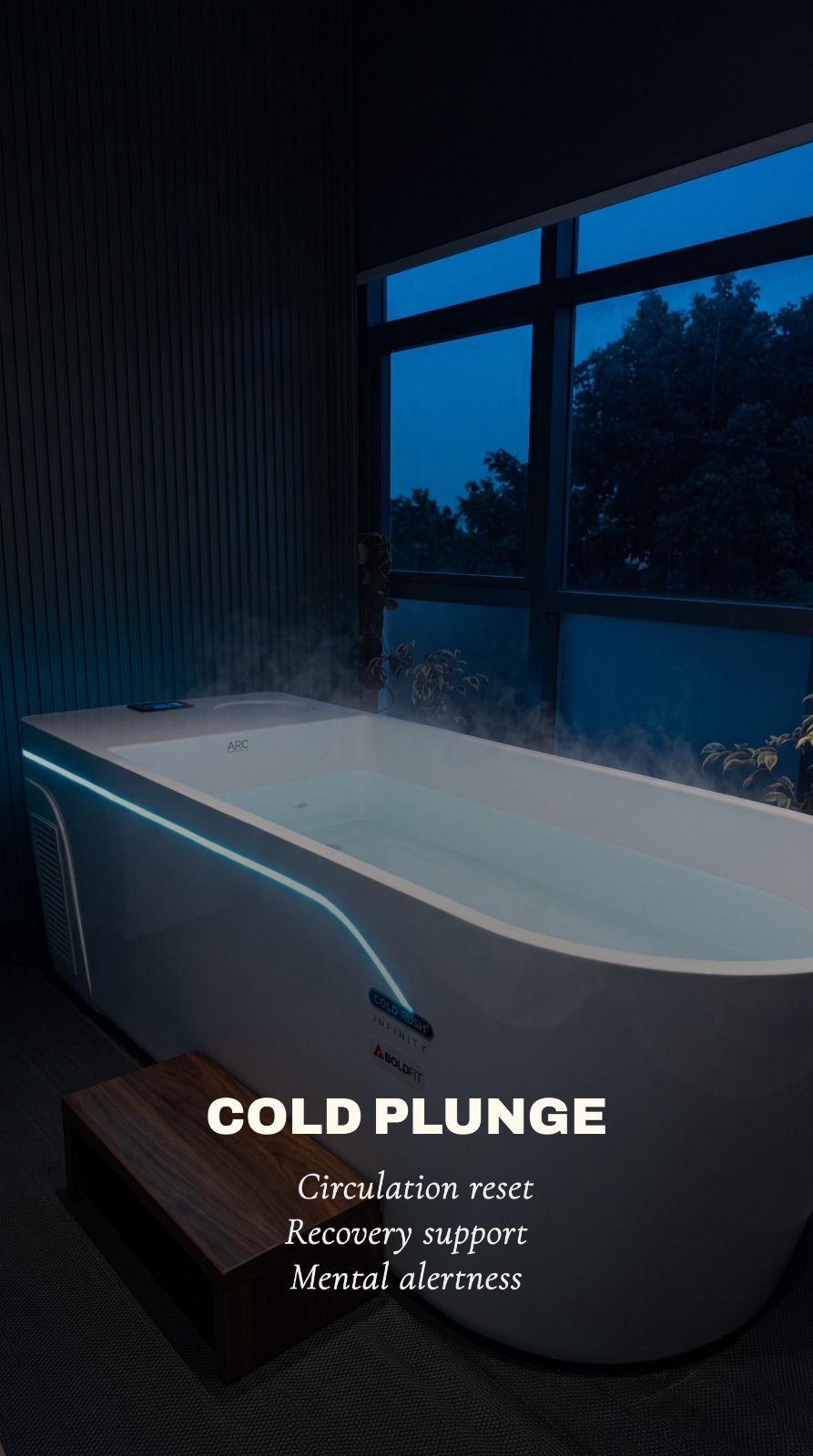
Cold water immersion · 10-15°C
Cold Plunge in Bengaluru
A few minutes in chilled water, guided breath by breath, at our HSR Layout studio. Short, structured, and never something you do alone.
A cold plunge is a short, deliberate immersion in chilled water, usually up to the shoulders, done with slow controlled breathing and under supervision. At VAURA Wellness in HSR Layout, Bengaluru, the water is held between 10°C and 15°C, first sessions run two to three minutes, and a team member stays with you from the moment you step in until you are dry and warming back up.
That is the whole practice. There is no equipment to learn and nothing athletic about it. What makes cold water immersion difficult is not the temperature but the first thirty seconds, when the breath shortens and the instinct is to gasp. Almost everything a good guided session does is aimed at those thirty seconds. Once the breath settles, the rest of the time is far more manageable than most people expect on the drive over.
Cold plunging has become one of the most searched recovery practices in Bengaluru, and a lot of what people read about it online is either overstated or borrowed from marketing. This page is the plain version: how a session at VAURA actually runs, what the cold is and is not likely to do, who should not be doing it, and how it differs from an ice bath, from whole body cryotherapy and from an infrared sauna.
The session
How a cold plunge at VAURA works
Five stages, start to finish. Most visits take well under an hour including the conversation before and the warming period after.
- Step 01
Suitability conversation
A short, unhurried chat before your first plunge. The team asks about training, medical history and how you respond to cold, and answers whatever you want to ask before you decide to go ahead.
- Step 02
Quick shower
You rinse off before entering the water. It keeps the plunge clean for everyone and takes a minute.
- Step 03
Entry and breath
You lower in gradually while a team member talks you through slow, controlled exhales. This is the part that decides how the rest of the session feels.
- Step 04
The agreed time
You stay in for the duration set beforehand, two to three minutes on a first visit, never beyond ten to fifteen minutes. You can step out earlier at any point.
- Step 05
Warming back up
You dry off and warm naturally rather than jumping straight into a hot shower. Most people feel the strongest effects in the ten to twenty minutes after they get out.
Want to try a first, short, fully guided plunge?
Temperature and duration
The numbers we actually work to
The plunge is held between 10°C and 15°C. That range is cold enough to be a genuine stimulus and mild enough that a beginner can stay composed in it with guidance, which matters more than chasing a lower number.
A first session is two to three minutes. From there people build gradually across weeks rather than within a single visit. Sessions do not exceed ten to fifteen minutes, and for most people there is no reason to go anywhere near that. Two to three sessions a week is a common rhythm for someone using the plunge as part of a recovery routine.
Longer and colder is not automatically better. The useful part of the practice is repeatability: a temperature you can return to twice a week for months is worth far more than one heroic session you never repeat.
Before your session
- Avoid a heavy meal in the hour beforehand
- Arrive hydrated; skip alcohol before a plunge
- Take the quick shower we ask for before entry
- Bring a towel and a change of clothes if you prefer your own
- Tell the team about any medical condition or medication
After your session
- Dry off and warm naturally rather than rushing into hot water
- Move gently: a short walk helps more than sitting still
- Expect the strongest effects in the following ten to twenty minutes
- Eat normally; the plunge is not a reason to skip a meal
First time
What a first plunge is really like
Nearly every first-time visitor arrives slightly nervous, and the nerves are usually about not knowing what the cold will do rather than the cold itself. So here it is, in order. You lower in and the breath immediately gets short and high in the chest. That is the cold shock response, it is normal, and it passes. Someone will be talking you through long exhales while it happens.
Around the thirty second mark the breathing settles and the water stops feeling like an emergency. The skin still registers cold, but the panic element is gone. From there, two minutes is a perfectly ordinary thing to sit through. Most people are surprised at how quickly the hard part ends, and a fair number ask to stay in slightly longer than agreed, which the team will usually talk them out of on a first visit.
Getting out is its own experience: warm, tingling skin, and for most people a distinctly awake, level-headed feeling that lasts a while. That is the part people come back for as much as anything to do with muscles.
If you have never done cold water immersion and would rather start somewhere drier and shorter, say so. A two to three minute session in the electric cryotherapy chamber is a common first step, and plenty of people move to the plunge from there.
What it may support
Why people use cold water immersion
- Commonly used to support muscle recovery and ease post-training soreness
- Supports healthy circulation as the body rewarms after immersion
- Helps reduce the heavy, fatigued feeling in the legs after hard sessions
- A structured way to practise composure under physical stress
- Many people describe feeling alert, warm and clear-headed afterwards
- An easy anchor habit for a consistent weekly recovery routine
These are commonly reported experiences and areas of ongoing research, not guaranteed outcomes. A cold plunge is not a treatment for any medical condition and does not replace medical care, sleep, nutrition or sensible training.
Who may consider it
Who the plunge tends to suit
- Runners, cyclists, lifters and racquet sport players managing training load
- People who want to build cold tolerance gradually rather than all at once
- Desk-based professionals looking for a short, decisive reset in the week
- Anyone already using sauna or cryotherapy who wants to round out the routine
- People who prefer a guided first attempt over trying cold water alone at home
If the reason you are looking is a specific joint, a recurring niggle or an injury, start with a physiotherapy assessment rather than with cold water.
Placing it in the week
When people commonly plunge
After training
The most common pattern. People come in after a gym session, a long run around Agara lake, or a weekend ride, and use the plunge to close the session out.
Rest days
On days without training, the plunge becomes the session itself, often followed by a warm-up period and a slow start to the rest of the day.
Before a demanding day
Some people book a morning slot specifically for the alert, awake state that follows, rather than for anything to do with muscles.
In a heat and cold cycle
Paired with an infrared sauna in the same visit, alternating warmth and cold, sequenced by the team so the session stays comfortable.
One nuance worth knowing: if your training goal is specifically muscle growth, some people prefer to leave a few hours between heavy strength work and cold immersion, and use the plunge on other days instead. Tell the team what you are training for and they will help you place it sensibly. If your legs are the main complaint, compression therapy in the same visit is an easy, seated addition.
Comparisons
Cold plunge vs cryotherapy vs infrared sauna
All three are available at the HSR Layout studio, and they are not interchangeable. This is the honest difference.
| Cold plunge | Whole body cryotherapy | Infrared sauna | |
|---|---|---|---|
| What surrounds you | Chilled water at 10-15°C, up to the shoulders | Dry, breathable cooled air at -85°C in an electric chamber | Infrared warmth in a private cabin |
| Typical duration | 2-3 minutes to start, never beyond 10-15 minutes | 2-3 minutes | A longer, slower session you settle into |
| How it feels | Slow, mentally demanding, breath-led | Sharp and fast, over before it becomes a struggle | Warm, quiet and passive |
| Practicalities | Shower first, towel and change of clothes needed | Dry throughout, no shower or change needed | Relaxed pace, allow extra time to cool down |
| Commonly chosen for | Post-training recovery and building cold tolerance | A fast whole body reset inside a busy day | Winding down, warmth and a slower routine |
Cold plunge vs ice bath
Physiologically they are the same idea. Practically they are not. A home ice bath starts wherever the ice puts it and warms steadily as the ice melts, so no two sessions match and hygiene depends entirely on how the tub is cleaned. A studio cold plunge is filtered, sanitised and held at a set range, which is what makes it possible to repeat the same session week after week and to build up sensibly rather than guessing.
Cold plunge and contrast therapy
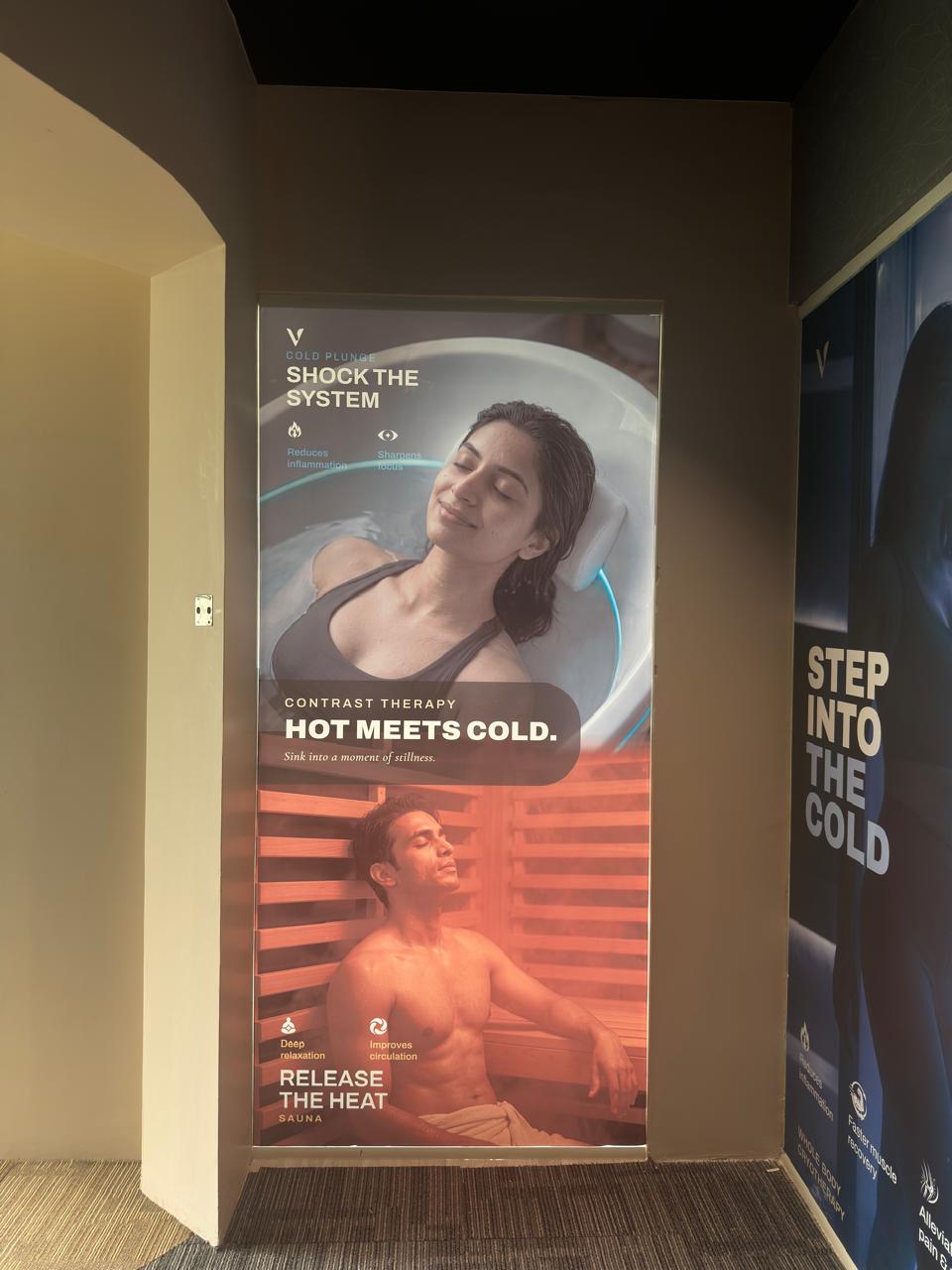
Contrast means alternating heat and cold in one visit, most often sauna into plunge and back again. It is a longer, more involved session than either on its own and it is popular with people who want the full ritual rather than a quick reset. The team sequences the rounds and keeps each cold exposure well within the limits above.
Safety and suitability
When not to get in the water
Cold water immersion places real demand on the heart and circulation, which is why every first visit begins with a suitability conversation rather than a waiver you sign without reading.
It is generally avoided during pregnancy, with cardiovascular conditions or uncontrolled blood pressure, with Raynaud's disease or cold urticaria, and with circulatory conditions such as deep vein thrombosis. Never plunge with open cuts or a skin infection. If you are managing a medical condition or currently under treatment, speak with your healthcare provider before booking, and tell the VAURA team what they said.
During the session: no breath holding, no hyperventilation routines picked up online, and no plunging alone. If you feel dizzy, numb beyond the expected cold sensation, or simply want out, you get out. Nobody at VAURA will encourage you to push past that.
Precautions in short
- Start at two to three minutes; build across weeks, not within one visit
- Never exceed ten to fifteen minutes in the water
- No plunging after alcohol or a heavy meal
- No open cuts, wounds or active skin infections
- Always supervised, always free to end the session early
- Speak with your doctor first if any condition is being treated
What to expect, plainly stated
Guided by our team
Every session is explained and supervised end to end.
Suitability discussed first
Some experiences may not be appropriate during pregnancy, with certain medical conditions, or while under treatment. Individual experiences vary, please speak with your healthcare provider and discuss suitability with the VAURA team before booking.
Hygienic, professionally maintained studio
Equipment and spaces are cleaned and checked between sessions.
Transparent, accessible pricing
Pricing is shared clearly during your consultation, no surprises.
Why VAURA
Why plunge here
VAURA is a wellness, recovery and longevity studio in HSR Layout, not a gym add-on. The plunge is temperature controlled and sanitised, every session is supervised, and first-timers are screened rather than simply pointed at the water.
It also sits alongside the rest of the recovery floor, so the plunge does not have to be a standalone trip. People pair it with whole body cryotherapy, localised cryotherapy for a specific joint, an infrared sauna for a heat and cold cycle, or compression therapy for tired legs.
If you expect to come more than a couple of times a month, the session packages make the habit easier to keep. You can read more about the studio and the team or simply send us your question before booking anything.
FAQ
Cold plunge questions
What is a cold plunge?
A cold plunge is a brief immersion in chilled water with a focus on steady breathing. At VAURA in HSR Layout the water is kept at 10–15°C; a first visit typically begins with two to three minutes and the team supervises the session. Suitability is discussed before entry.
Is colder always better in a cold plunge?
No. Colder water does not automatically mean a better experience or outcome. VAURA uses a 10–15°C range and starts first visits briefly, with time agreed beforehand. Comfort, health history and supervision matter more than chasing a lower temperature.
How cold is the water at VAURA and how long do I stay in?
The plunge is held between 10°C and 15°C. First sessions are two to three minutes, and even experienced regulars do not exceed ten to fifteen minutes. Time in the water is agreed before you get in, and you can end the session at any point.
What is the difference between a cold plunge and cryotherapy?
A cold plunge is cold water on the skin for a few minutes at 10-15°C. Whole body cryotherapy is dry, cooled air in an electric chamber at -85°C for two to three minutes. The plunge feels slower and more mentally demanding; cryotherapy is sharper, drier and quicker, with no change of clothes or towel needed afterwards. Many people at VAURA use both for different days of the week.
Is a cold plunge the same as an ice bath?
They work the same way, but an ice bath is usually a tub filled with ice that drifts in temperature as the ice melts. A cold plunge is a filtered, temperature-controlled and sanitised bath held at a set range, so each session is repeatable rather than a guess.
What should I do before my first cold plunge in Bengaluru?
Avoid a heavy meal immediately beforehand, arrive hydrated, and take the quick shower we ask for before entry. Bring a change of clothes and a towel if you prefer your own. The team runs a short suitability conversation before your first plunge.
What does it actually feel like?
The first twenty to thirty seconds are the hardest part: the breath shortens and the instinct is to gasp. That is exactly what the guided breathing is for. Once the breath settles, most people find the remaining time far more manageable than they expected, and describe the period afterwards as alert, warm and clear-headed.
How often should I cold plunge?
Two to three sessions a week is a common rhythm for people using it as part of a recovery routine. More is not automatically better, and the right frequency depends on your training load, sleep and goals, which is worth discussing with the team.
Who should avoid cold water immersion?
Cold plunging is not suitable for everyone. It is generally avoided in pregnancy, with cardiovascular conditions or uncontrolled blood pressure, with Raynaud's disease or cold urticaria, and with circulatory conditions. Never plunge with open cuts or a skin infection. If you are managing a medical condition or under treatment, speak with your healthcare provider first and with the VAURA team before booking.
Should I do a cold plunge before or after my workout?
Most people at VAURA plunge after training or on a rest day. Cold immediately after heavy strength work is sometimes avoided by people specifically chasing muscle growth, so tell the team what you are training for and they will help you place it in the week.
Can I combine a cold plunge with an infrared sauna?
Yes. Alternating heat and cold in the same visit is one of the most common ways people use the studio, and the team will sequence it so the session stays comfortable and within safe limits.
Do I need to book, or can I walk in?
Booking is better. The plunge takes one person at a time and evening slots fill first, so a call or a WhatsApp message ahead of time saves waiting.
Where can I do a cold plunge in Bengaluru?
VAURA Wellness runs guided cold plunge sessions at its studio on 22nd Cross, 20th Main, Sector 2, HSR Layout, Bengaluru 560102, within easy reach of Koramangala, Sarjapur Road, Bellandur, BTM Layout and Agara.
How much does a cold plunge session cost?
Pricing for single sessions and for multi-session packages is shared clearly during your enquiry, before you commit to anything.
Areas we serve
Cold plunge in your neighbourhood
Cold Plunge in HSR Layout
Routes by sector, parking on 22nd Cross, the quietest booking windows, and how HSR regulars fit a plunge around the gyms on 27th Main.
Read the HSR Layout guideCold Plunge near Koramangala
The studio is in HSR Layout, not Koramangala. This is the honest drive, block by block, the traffic windows worth avoiding, and how to make one trip count.
Read the Koramangala guideLocation
Where to find the plunge
692/1, 22nd Cross, 20th Main, Sector 2, HSR Layout, Bengaluru – 560102, Karnataka
+91 76250 84563
Within easy reach of Koramangala, Sarjapur Road, Bellandur, BTM Layout, Agara and Bommanahalli.
Ready when you are
Make Wellness Part of Your Everyday
Begin your VAURA experience in HSR Layout, Bengaluru.
Tell us what you are recovering from and we will suggest a sensible first session length.
5.0
Rated on Google
9
Guided therapies
3 min
Typical cryotherapy session
7 days
Open every week